NASA Internship
Summer 2023
This was my first internship, where I defined three objectives.

Objective 1
Task Category Analysis
Can we group similar task categories together based on metabolic rate, so we can accurately substitute data when a crew member lacks historical data for a specific task category?

Objective 2
Reliable Heart Rate Capture in Constrained Environments
How can we reliably capture heart rate signal from the pool in the NBL when water attenuates bluetooth signal?

Objective 3
Hybrid Space Suit Simulator (HS3) Testing
Can I improve the HS3, assist with conducting human subject testing, and capture design needs?
Objective 1: Task Category Analysis
Before heading to the ISS, astronauts train in the Neutral Buoyancy Laboratory (NBL). During training, crew perform a series of maintenance tasks on the outside of the mock ISS to simulate the work they will do during ISS extravehicular activities (EVAs). During training, each crew member's metabolic rate is recorded and timestamped according to which task is being completed.

ISS EVA Task Categories
Before beginning my analysis, I had to teach myself Python. A few youtube videos and a ton of package installation issues later, I had the data loaded and a KMeans analysis completed. The learning process took me the full three month duration of my internship. It was an incredibly rewarding process, and I learned how to ask the right questions and how to implement unsupervised machine learning (KMeans) (both from scratch and using sklearn). I presented my work as a poster at the end of my internship.
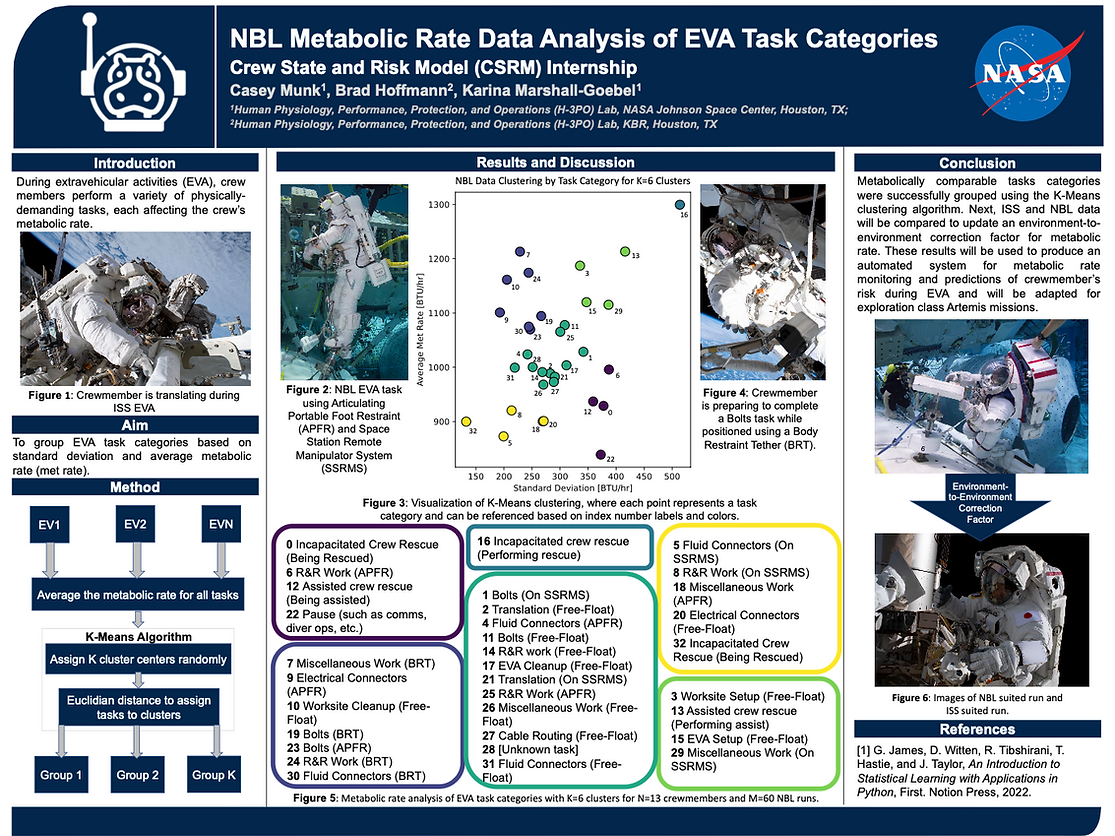
NBL Metabolic Rate Data Analysis of EVA Task Categories Poster Presentation
Objective 2: Reliable Heart Rate Capture in Constrained Environments

Schematic of data transmission to pool deck.

View of the NBL one level above the pool deck.
In addition to metabolic rate, we also capture heart rate during NBL training runs. However, water attenuates the Bluetooth signal from the PolarH10 devices, so I was researching a way to get continuous heart rate data transmitted to the pool deck without using Bluetooth.

Testing multiple different cables.

Testing cables extended to 500 ft.
With the help of my mentor Brad Hoffmann and NBL technicians, we tested many different cords and USB-over-ethernet connectors to see if we could get data sent over the 500 foot length of the umbilical chord. Unfortunately, we did not find a solution during my time in person there, but we learned what didn't work which was a great step forward. This was my first time being exposed to hardware solutions, IoT, and hands-on testing of devices. Although we didn't find a solution, this was one of the most rewarding parts of my internship because it pushed me out of my comfort zone.
Objective 3: Hybrid Space Suit Simulator (HS3) Testing
When I wasn't working on my first two objectives, I would join the team for HS3 testing. If you'd like to learn more about the HS3, read the article my mentors and co-workers wrote!
I assisted with live testing of volunteers performing a series of tasks in the suit. I helped set up different sensors such as iButtons for thermal data, PolarH10 for heart rate monitoring, and the Portable Life Support System (PLSS) for cooling. Additionally, I learned how to sew and made coverings for the side of the chest plate as a solution to user discomfort in that area. This is shown to the right by the arrows.

Very excited Casey wearing the HS3.
During the last week of my internship, I was able to go into the HS3 myself and pose as the subject for a risk mitigation exercise (middle image).

Raking at the geology station.

Realizing I might have a shot at my acting career.

Chip sample (hammering) at the geology station.
At the end of the summer, I couldn't believe my time at Johnson Space Center was over. This internship was one of the most rewarding experiences of my life, and I couldn't bear to stop there. I requested to work part-time remotely during my Junior year at Virginia Tech, and I'm so thankful I was able to!
My Second NASA Internship
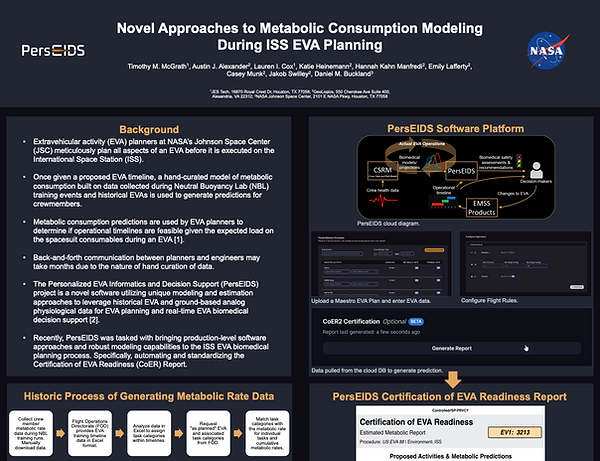
In October, 2023, I began my work as a part-time intern and I split my time between the Crew State and Risk Model (CSRM) Team and the Data Science and Software Team. My time at NASA allowed me to contribute to two publications, presented at the ISS RDC Conference in 2024. You can check them out below!

Special thanks to all my mentors and colleagues throughout this internship. I learned so much here, and it was an incredible experience!